
A BILLBOARD WITH A LOT TO SAY
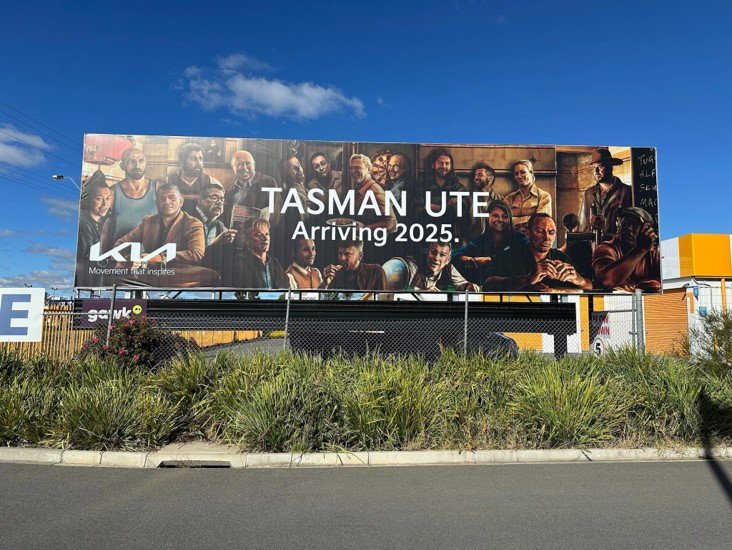
Image of Tasman Ute Billboard (Athanassiou, 2024)
This week, we explored how images create meaning through semiotics, which is the science of signs and meaning. KIA’s Tasman Ute billboard, part of the 2024 ad campaign, is a strong example of how signs, signifiers and the signified work together to communicate a concept.
Denotatively, the Billboard features 21 prominent Australian athletes, including Buddy Franklin, Ash Barty and excel Alexander Volkanovski. The darkly lit scene displays the bold white text, “Tasmin Ute. Arriving 2025” with the KIA logo subtly positioned in the bottom left corner. Notably, the unit itself is absent, causing the audience to rely on the signifiers, the logo and the word “Ute” to infer the product being advertised.
In semiotic terms, the key signifies include the athletes, dark background, bold text, and the KIA logo. Instead of visually showcasing the vehicle, the campaign builds associations between the Ute and the qualities embodied by the athletes – strength, resilience and Australian identity. Representation is a key component in how meaning is produced and exchanged (Hall, 1997). By leveraging well-known sports figures, Kia implies that the Tasman Ute shares their traits, reinforcing a patriotic ideology of Australian success.
The dark lighting creates a sense of mystery, drawing attention to the bold text and prompting curiosity. The placement of the KIA logo encourages continuity of thought, leading viewers to connect the brand with the new Ute engagement. Viewers may be compelled to search for more information, aligning with the campaign’s goal of generating anticipation.
While many interpret the Billboard as a celebration of Australian identity and the arrival of a new vehicle, alternatively there are readers that exist that do not get this message. It evident that “meaning is not an absolute, static concept to be found neatly parcelled up in the message”(Fiske, John and Jenkins, Henry 2010, p. 43). Not all Australians may recognise the athletes, altering their perception of the image. Non-sports fans or audiences that have just come to Australia, might struggle to associate the figures with the Australian sporting culture, instead interpreting the image as a diverse representation of people, suggesting that the ad is for “everyone.”
A small subset of viewers may entirely miss the intended message. Without familiarity with the KIA logo or the term “Ute,” they may not realise the ad is for a vehicle at all, instead perceiving it is an endorsement for Australian athletes.
KIA’s Tasman billboard exemplifies how advertisers construct meaning beyond direct representation. Through strategic use of signifiers, sports stars, dramatic lighting, subtle logo and bold text, the campaign connects the Ute with Australian strength and success. However, as semiotics reveals, meaning is not fixed and varies based on individual interpretation. The campaign’s success lies in it’s ability to provoke curiosity and engagement demonstrating the power of visual communication.
REFERENCES:
 Mikaela's San Giorgio - Digital Portfolio
Leave a comment