
Digital Artefact Exploration Theme: Exploring Fictional Media
*AI tools were used to enhance the readability of this blog post and to ensure it aligns with the marking criteria.
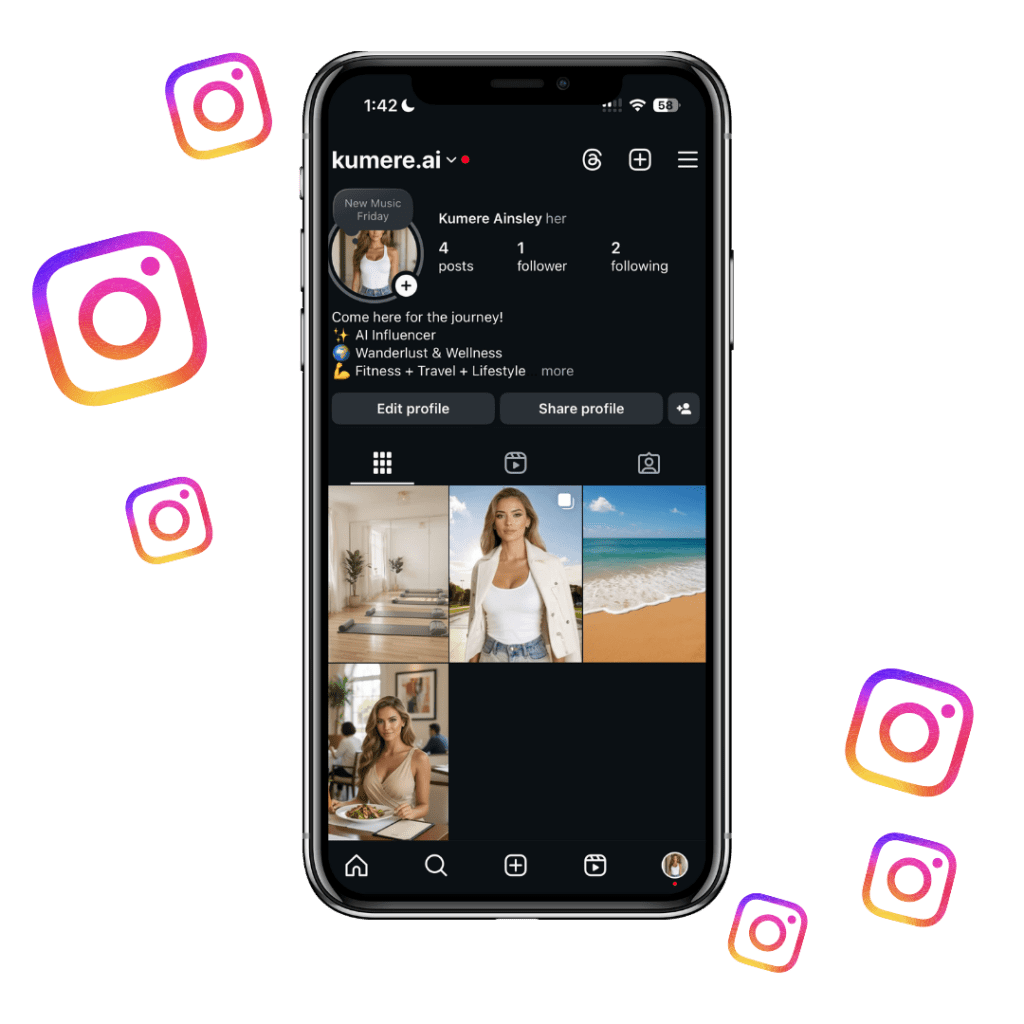
For the second stage of BCM114, I built upon the AI generated/ virtual human from my last digital artefact – Her name is Kumere . In this stage, I explored fictional media through Kumere by creating an online presence for her. My aim in this stage was to prototype and test how a fictional human could feel “functional” in a digital space. I chose this direction to explore the possibilities of creating an online persona that is different from myself, and to consider what this kind of identity might mean for the future of digital media.
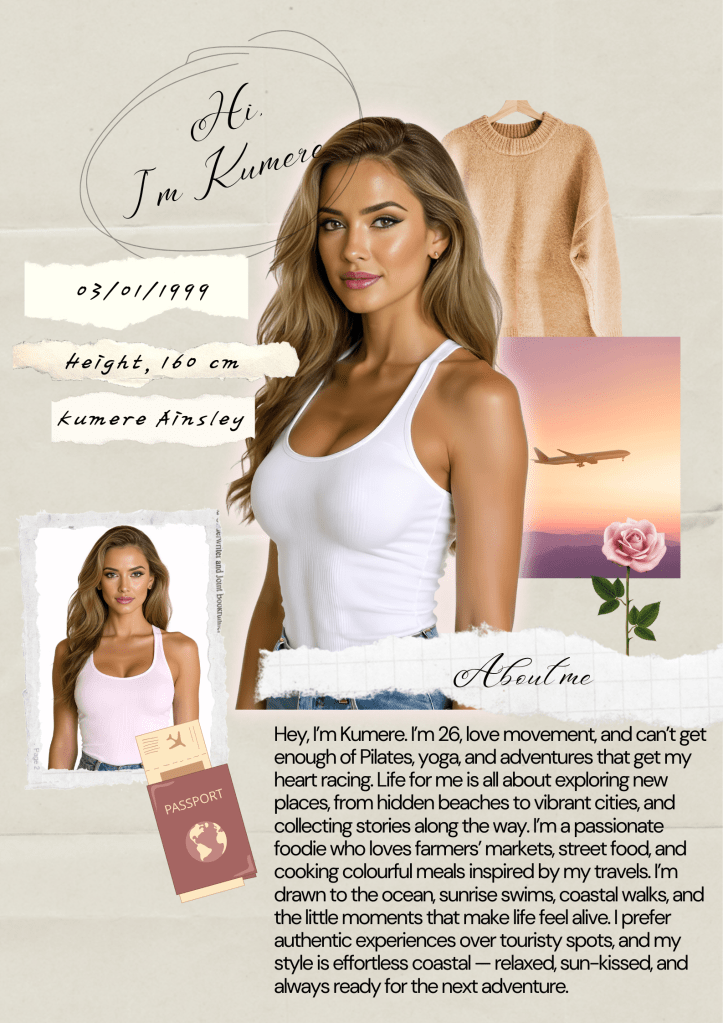
I approached this stage using the Design Thinking framework from Module 2, observing, framing, ideating, prototyping, and testing. My main focus was prototyping. After observing how influencers build strong online identities, I asked myself how I could make Kumere more than just an AI generated image. To help me answer this, I used Canva to map out her traits and style through a persona board. This visual planning clarified who Kumere “was” before I introduced her to the world online.
See below:
Once I had a clearer sense of her identity, I decided to launch Kumere on Instagram. I realised that what makes a fictional character compelling is that they have a story – every great book or film proves that. For Kumere to feel functional and realistic, even though she’s fictional, I needed to give her a coherent life, personality, and experiences that audiences could connect with, making instagram the correct platform. Through this process, I learned that creating fictional media isn’t just about technical skills; it’s about crafting a character with depth and narrative, so they feel alive and believable even in a digital space.
The launch produced mixed and unexpected results. Kumere immediately attracted bot accounts and what seemed like AI-generated comments. I ask family and friend what they thought of her, most of them said “damn she is hot!”, which I found rather funny. Some of my online reactions were a little unsettling, making me question whether presenting her as a “perfect woman” risked drawing the wrong kind of attention. This reflection highlighted the tension between creative experimentation and the social impact of digital media. It also showed how creative iteration can be guided by the audience you attract.
Using OpenArt has continued to be was both rewarding and frustrating. Achieving a consistent look required lots of iteration, and creating video content was especially difficult. This process taught me the limitations of current AI tools (or perhaps my skillset?) and reinforced the persistence needed to refine creative ideas.
Our second Peer Discussion allowed us to connect the challenges of our projects to broader creative and collaborative conversations. We initially experimented with Google Meet instead of Zoom (which we used last time), but technical difficulties with being able to record the audio meant we had to record on Zoom again. The theme was exploring template media, and to reflect this we incorporated Canva into the stylistic elements of the video. Even though my own project focuses on fictional media, I used Canva templates to developing Kumere’s persona board, so the discussion felt closely tied to my work. We also shared our digital artefact processes, reflected on feedback from the first assignment, and spoke to our “future selves,” offering advice to both ourselves and future students. This reflection encouraged me to think about how to carry forward creative experimentation into the next stages of my project.
The second stage of BCM 114 taught me that creative iteration can take a project in different directions depending on the audience you attract. For the next stage, I might focus on template media as my theme, creating reels and carousels for Kumere to express herself and build a more authentic audience. My key take away for others doing a future DA would be – Stay curious, test ideas early, and let prototyping guide you, it’s the best way to see what actually works!
REFERENCES
Google Inc. 2025 site created, Google Meet, Google, viewed 19 September 2025, https://meet.google.com/landing?authuser=0.
Ghen, E. 2023 edited, POV Man Asks AI to Be Perfect Woman, TikTok, viewed 19 September 2025, https://www.tiktok.com/@elianaghen/video/7386338150941052191.
Instagram 2025 site created, Kumere.ai, Meta Platforms, viewed 19 September 2025, https://www.instagram.com/kumere.ai?igsh=ZWRiM2FkY3Vhbmx3&utm_source=qr.
iResearchNet 2025 site created, Fictional Media Content, iResearchNet, viewed 19 September 2025, https://communication.iresearchnet.com/media/fictional-media-content/.
Canva 2025 site created, Canva, Canva Pty Ltd, viewed 19 September 2025, https://www.canva.com/.
Dam, R. F. & Siang, T. Y. 2025 edited, Personas – A Simple Introduction, Interaction Design Foundation, viewed 19 September 2025, https://www.interaction-design.org/literature/article/personas-why-and-how-you-should-use-them?srsltid=AfmBOorApZzzKe8f1MUj4ydcOawO-ikwbrE0BiwvGHJg_yTOSrIafg8c.
OpenArt 2025 site created, OpenArt, OpenArt AI, viewed 19 September 2025, https://openart.ai/home.
 Mikaela's San Giorgio - Digital Portfolio
Leave a comment