For my BCM206 Digital Artefact, I am using DA Mode 3: Infrastructure Design to create a central information system for my destination wedding. With the wedding now less than three months away, information is spread across emails, spreadsheets, vendor documents, Canva files, screenshots, handwritten notes and conversations. Some information still only exists in my head. As more people become involved in the planning, having information scattered across different places is becoming increasingly difficult to manage.
My concept came from a problem I am already experiencing. I wanted to take something that is currently consuming a lot of my time and use it as an opportunity to learn through my DA. The final output will be a digital and physical wedding “Bible”, but the focus of the project is the infrastructure behind it: how information enters the system, how it is organised and updated, and how it can then be accessed by the people who need it.
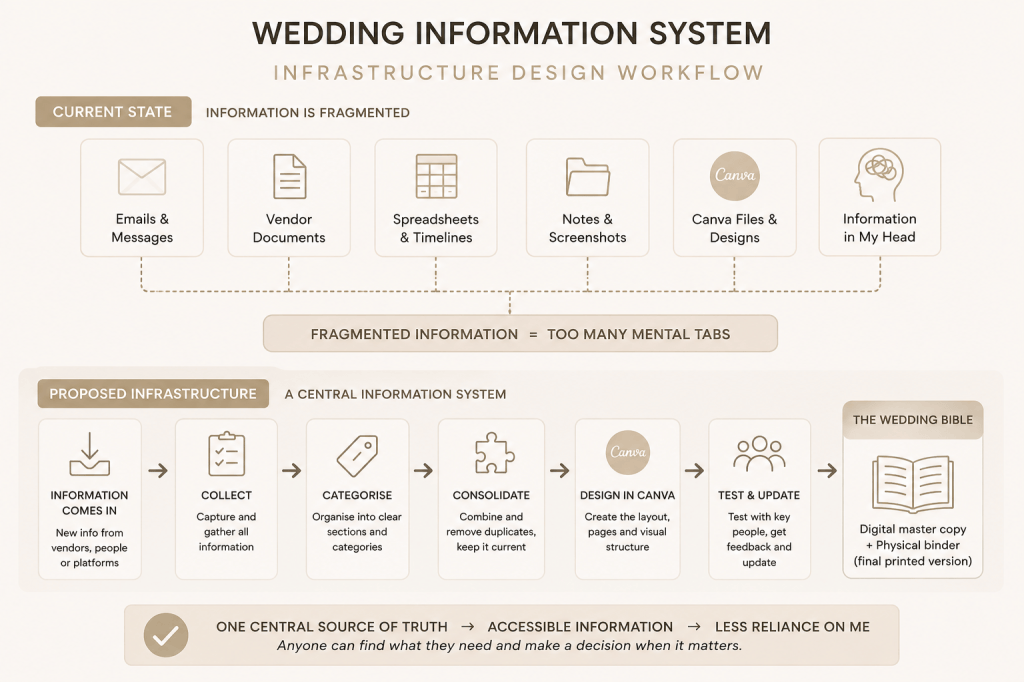
As displayed in the diagram I created with the assistance of ChatGPT (OpenAI 2026), I have mapped out my proposed system. Information will first come in from different sources before being collected, categorised and consolidated. From there, relevant information will be designed and organised in Canva (Canva 2026), before being tested with users and updated where necessary. The digital version can be shared with people including my partner, maid of honour and wedding coordinator, with a final physical copy printed for the wedding.
Castells’ (2011) concept of network-making power has helped me think about why I am structuring the system this way. Castells discusses how networks can be programmed around particular goals and how different networks can be connected. I am applying this by treating my emails, documents, spreadsheets and other sources as separate parts that need to be connected around one goal: making the right information accessible to the right people. Instead of information having to continually flow through me, the system redirects it into a central resource. This should allow other people to find information and make decisions independently, reducing the reliance on me as the main source of knowledge.
Iteration will also shape how I develop the system. Siena, Malcolm and Kennea (2025) explore the development of ideation and iterative design skills through testing and continued improvement. I will apply this by asking the people who will actually use my system to locate information without my help. If they cannot find something, misunderstand it, or still need to ask me, this gives me a specific problem to address in the next iteration. Testing is therefore part of my methodology, rather than something I will only do once the resource is finished.
The utility of the project comes from making wedding information easier for others to access. Having worked at many weddings, one rule I have always believed in is: don’t bother the bride on the wedding day! Ultimately, my test is simple: can someone find what they need, when they need it, without asking me?
If they can, the infrastructure has done it’s job.
For my pitch video, I used InShot to edit primarily my own footage from my personal wedding season. As the DA is still in the ideation stage, I do not yet have footage of it; it’s still a concept. Using footage from my own life allowed me to visually show the context behind the project while the infrastructure is still being developed.
References
Canva 2026, Canva, viewed 18 August 2026, www.canva.com
Castells, M 2011, ‘A network theory of power’, International Journal of Communication, vol. 5, pp. 773–787, https://ijoc.org/index.php/ijoc/article/view/1136/553.
InShot 2026, InShot: Video Editor & Maker, viewed 20 August 2026, www.inshot.com
OpenAI 2026, ChatGPT, OpenAI, viewed 20 August 2026, www.chatgpt.com
Siena, FL, Malcolm, R & Kennea, P 2025, ‘Developing ideation & iterative design skills through human-centred product design projects’, Proceedings of the 27th International Conference on Engineering and Product Design Education (E&PDE 2025), pp. 595–600, doi:10.35199/EPDE.2025.100, https://www.designsociety.org/publication/48641/developing_ideation_iterative_design_skills_through_human-centred_product_design_projects.
AI Statement
ChatGPT (OpenAI 2026) was used to help structure my existing ideas into a logical format, improve sentence flow within my script, and assist in creating the workflow diagram used in this post. All project ideas, research decisions and final content remain my own.
I created and edited the pitch video myself using InShot (2026), primarily using my own footage from my current wedding planning.
Stock footage from Canva (2026) was used behind the three question slides: concept, methodology and utility. The only AI feature I used within InShot was the automatic captioning tool, which generated an initial version of the captions. I manually reviewed and edited these captions to correct inaccuracies, wording and punctuation.


Leave a Reply