Learning Through Failure: Rethinking My Wedding Information Network
When I pitched my Digital Artefact in A1, I thought I had a fairly simple solution to a very messy problem. My wedding information was everywhere, so I would bring it together into one digital and physical ‘Wedding Bible’. My tutor’s feedback encouraged me to consult the DA Mode instructions and connect the project more clearly to Future Networks. Looking back, this became important because the biggest thing I learned was that creating a network is not necessarily about forcing everything into one place.
Following advice from ModeM, I created a ‘sanitised version’ for my public DA. Personal information such as guest names and contact details has been removed, which explains any gaps or blanked-out sections.

SEE BELOW TO VIEW THE DA WEDDING BIBLE COMPONENTS PUT TOGETHER IN CANVA:
LINK TO INFRASTRUCTURE REPORT: https://mikaelasangiorgio.com/2026/10/03/bcm-206-mode-3-infrastructure-report/
Learning Moment 1: I misunderstood ‘centralisation’
In A1, I used Castells’ (2011) concept of network-making power to explain how my separate sources of information could be connected around a common goal. Castells explains network-making power through the ability to program networks and create connections between them.
At the time, I interpreted this quite literally. My plan was to collect information from Excel, Word, emails, venue documents and other sources and eventually consolidate everything into a Canva document.
Once I actually started doing this, I realised I was creating another problem while trying to solve the first one. Detailed spreadsheets and Word documents already worked well for what they were designed to do. Rebuilding everything in Canva took a huge amount of time and sometimes made the information less functional.
My first major learning was therefore that centralised access does not require centralised production.
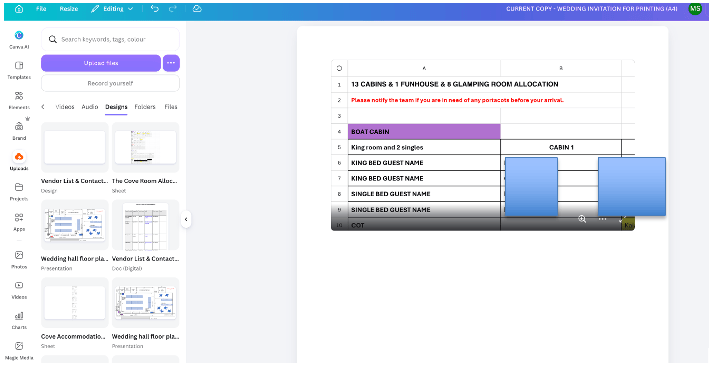
See the screenshot below; I tried to put an Excel spreadsheet into Canva and it was not formatting correctly. (I concluded it’s best to just print this from Excel and add into the physical book later):
Learning Moment 2: AI was not the shortcut I expected
My biggest learning moment happened after attending the Fortuna One seminar in Sydney (Fortuna One, 2026). I was particularly interested in seeing advanced AI workflows and came away thinking that I could be using AI much more effectively in my own work.
This led me to experiment with connecting ChatGPT and Canva. I gave ChatGPT my Canva design, Word documents, Excel files and instructions and asked it to help build the Wedding Bible which plugged into Canva.
This became a lot harder than I expected.
I spent hours going backwards and forwards with prompts. The AI could create something quickly, but the pages often looked generic, information was missing and it sometimes changed things I had not asked it to change. At one point, after looking at another version, I literally asked ChatGPT: “where is my info?” It then acknowledged that the generated Canva did not contain all the information I had supplied.
See attached (so generic and irrelevant to what I needed. Was not impressed with the output. IT lacked utility in its relevance and content):
That was probably the moment the lesson clicked for me. Generating something quickly is not the same as building something useful.
Canva does support Word and spreadsheet files, but its own documentation shows that different file and data types have different import requirements and limitations (Canva 2026). My experience made me more critically aware of platforms rather than assuming that because a platform can accept information, it is automatically the best environment for that information.
Learning Moment 3: Failure changed the project
Siena, Malcolm and Kennea (2025) discuss iterative design as part of developing ideas through human-centred design practice. This became much more meaningful to me through this project because iteration was not just making small aesthetic improvements. Eventually, I had to accept that my original architecture itself needed to change.
I stopped trying to make Canva do everything.
Excel now remains useful for structured data, Word for detailed operational documents, Canva for visual communication, AI for assistance, and the physical Wedding Bible brings relevant outputs together. AI is still part of my process, but I now see it as one node within the network rather than the thing controlling the whole network.
Castells’ later revisiting of network society also acknowledges the need to reassess network theory against significant technological and social change (Castells 2023). On a much smaller scale, that is what this project required me to do: test my original understanding against what was actually happening and be willing to change it.
My Wedding Bible is still unfinished, and realistically it will keep changing until the wedding. I no longer see that as the failure of my DA. The biggest outcome has been learning how to decide when to keep pushing an idea and when the evidence is telling me to change direction. I will keep building my tables, spreadsheets using the approrpate software, then I will bring it together in the printing process.
My original success test was: can someone find what they need without asking me?
Now I would add: can they trust what they find, and am I using the right tool to give it to them?
References
Canva 2026, ‘Check file upload formats and requirements for Canva’, Canva Help Centre, viewed 3 October 2026, https://www.canva.com/en_au/help/upload-formats-requirements-variantb/ .
Castells, M 2011, ‘A network theory of power’, International Journal of Communication, vol. 5, pp. 773-787.
Castells, M 2023, ‘The network society revisited’, American Behavioral Scientist, vol. 67, no. 7, pp. 940-946, doi:10.1177/00027642221092803.
Fortuna One 2026, Fortuna One, viewed 3 October 2026, www.fortunaone.com
Siena, FL, Malcolm, R & Kennea, P 2025, ‘Developing ideation & iterative design skills through human-centred product design projects’, Proceedings of the 27th International Conference on Engineering and Product Design Education (E&PDE 2025), pp. 595-600, The Design Society, doi:10.35199/EPDE.2025.100.
Generative AI acknowledgement:
Generative AI formed part of both the Digital Artefact development and my reflection on the process. I used ChatGPT and ModeM to test workflows, explore infrastructure decisions and assist with organising and editing this report. All AI-generated material was reviewed and edited by me.


Leave a comment