
Reintroducing The Golden Sausage for the final time: A Local Game Going Places
For my BCM215 Digital Artefact (DA), I have spent the semester investigating The Golden Sausage, a family card game created by Wollongong dad, Joel Bettson (The Golden Sausage 2026) . Joel works with my partner Brad, which has given me a unique opportunity to follow the development of a local game and business from the ground up.
Using the Mechanics-Dynamics-Aesthetics (MDA) framework developed by Hunicke, LeBlanc and Zubek (2004), I set out to investigate how the game’s mechanics influence player interactions and the experiences they create. What I hadn’t anticipated was how much The Golden Sausage would grow outside university while I was studying it. From local newspaper and radio coverage to Joel’s first market stall, the game was developing in the real world alongside my research. I started by investigating how people played The Golden Sausage, but ended up learning just as much about how it was becoming part of their everyday lives.
Developing My DA: An Eleven-Week Playtesting Portfolio
My DA is a visual playtesting portfolio created in Canva (Canva 2026), documenting my interactions with The Golden Sausage throughout the semester. Each weekly entry includes a structured table recording the players and context, playtest focus, mechanics, dynamics, aesthetics, overall MDA connection, key findings and what I wanted to observe next. Photographs and screenshots accompany my observations, helping jog my memory and providing context for particular moments.
I chose this format because I enjoy having structure, but also wanted something visual and accessible that I could eventually share with Joel. The consistent format made it easier to compare findings, recognise patterns and revisit earlier questions as my understanding developed.
My approach was also influenced by Choi et al. (2016), whose research explores how playtesting becomes more useful when it has a clear purpose. I found this particularly relevant because I wasn’t designing the game myself, but wanted to understand what I could learn from observing it. Rather than simply recording whether people enjoyed playing, I began using earlier observations to guide what I paid attention to next. For example, questions about card clarity raised during my Week 3 university playtest became increasingly relevant when observing how new players understood and handled the cards in later weeks.
Although I had a focus each week, I deliberately wanted gameplay to remain natural. Rather than announcing what I was observing beforehand, I paid attention to spontaneous comments, decisions and reactions during ordinary games. This allowed me to maintain the personal nature of the project while developing a more critical understanding of what was happening.
Key Findings: From Teaching the Game to Watching Others Play
Looking back through my portfolio, one of my biggest realisations is how much my relationship with The Golden Sausage changed. During the earlier weeks, I was actively introducing people to the game, explaining the rules and observing their initial reactions. By Week 6, my observations had become more specific. Brad’s brother Paul suggested adding small symbols to the corners of cards so their actions could be identified while holding a fanned hand, while four-year-old Rosie participated through recognising pictures, rolling dice and watching others play.
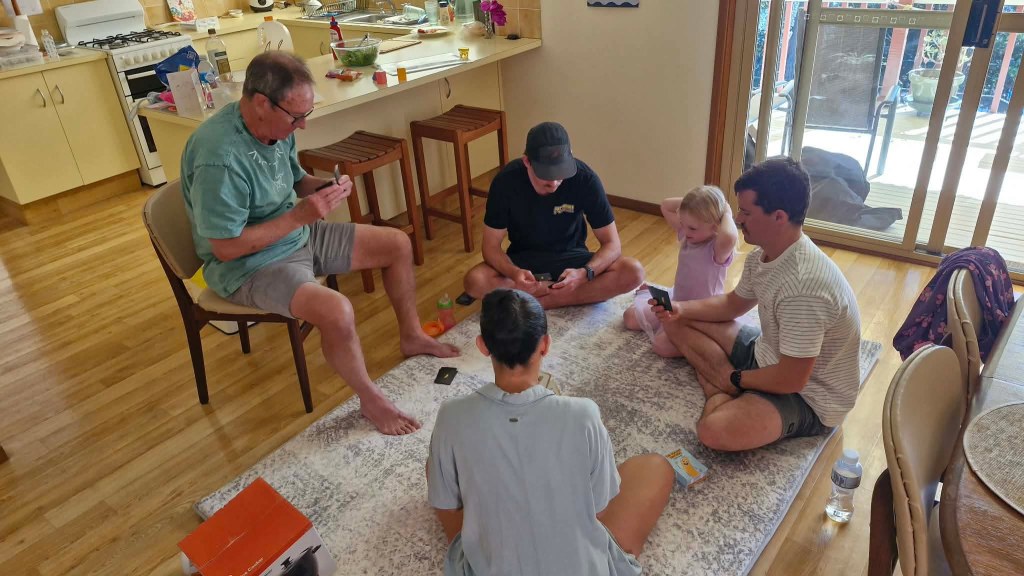
Figure 1. Family Play test with The Burleigh Family – Observing different approaches to learning and participating in the game.
However, some of my most interesting findings came later, when I was no longer organising every game. In Week 9, my maid of honour Melika asked me to bring The Golden Sausage to my hens weekend. Although we never got around to playing, I found it interesting that someone else was now requesting the game.
That same week, I gave my mum a copy purchased at Joel’s Kiama Market stall to pass on to Dad as a belated Father’s Day present. Brad and I had originally taught my family how to play during a camping trip in Lakes Entrance months earlier, and my ten-year-old sister Danii had been asking for her own copy ever since.
In Week 10, Mum sent me a video of Dad and Danii playing together at home in Melbourne, referring back to the cards and playfully bickering over how certain actions worked. I loved watching this because Brad and I weren’t there to explain anything. They were working through the game themselves, which also brought my earlier findings about card clarity full circle. Even players who had previously learnt the game still needed accessible instructions.
By Week 11, I realised I had gone from teaching people how to play to watching a small network of people enjoy the game independently. What initially felt like less substantial research was actually evidence of something I hadn’t expected to investigate.
Applying MDA: What the Research Helped Me Understand
The distinction between what designers create and what players experience became increasingly important throughout my research. Hunicke, LeBlanc and Zubek (2004) explain how mechanics establish the game’s systems, while dynamics and aesthetics emerge through player interaction. Initially, I used these categories to organise my observations, but gradually became more interested in how they influenced one another.
Chircop (2016) helped extend this thinking by examining board-game experiences through the relationship between rules, chance and interaction. This encouraged me to consider why the same mechanic could produce different outcomes depending on the players and circumstances. For example, when Brad’s mum Toni unexpectedly won using the Mind Reader card in Week 4, the excitement came from the timing and surprise of the result rather than simply the card’s function.
Dillon’s (2010) emotion-based approach to game design further encouraged me to consider why relatively simple games can create strong reactions. Although his work focuses on video games, its emphasis on emotional engagement helped me recognise how anticipation, competition and interaction shape The Golden Sausage. A strategic move that creates satisfaction for Brad might create frustration for his opponent, demonstrating how the emotional experience extends beyond what the designer has written into the rules.
My Assessment 1 feedback also encouraged me to investigate whether a game aimed at children might have limitations in its complexity. Bendixen-Noe (2010) explores how board and card games can support children’s learning, which helped me recognise that participation doesn’t necessarily require understanding every rule independently. As an OOSH educator, I found Rosie’s involvement particularly interesting because she could participate through observation, repetition and smaller actions.
Similarly, Issifou et al. (2026) examine how preparation, interaction and progressively developing understanding contribute to learning through an experiential card game. This offered a useful comparison with Week 6, when we introduced Paul through individual play before experimenting with teams. Meanwhile, Brad’s ability to develop strategic card combinations challenged the assumption that accessible mechanics necessarily produce a simple experience. I came to appreciate how different players can find different levels of challenge within the same rules.
Martínez Elizalde, Astengo Noguez and López Salas (2025) investigate the challenges of applying MDA effectively, particularly when developers concentrate on mechanics without fully considering player experience. This interested me because Joel is a first-time designer who created the game with his children and has continued developing it through experimentation. It made me curious about which experiences he deliberately designed and which emerged through trial and error.
Adams and Atman (1999) also helped me understand iteration as a process of revisiting information and using it to guide future decisions. I could see this in my portfolio as questions about card clarity resurfaced across Weeks 3, 6 and 10. My findings weren’t eleven unrelated observations; they were becoming connected insights that developed over time.
Reflecting on My DA: When the Findings Became Less Obvious
From Week 8 onwards, my relationship with The Golden Sausage began changing. Instead of organising another dedicated playtest, I visited Joel’s first Kiama Market stall, where I observed how he introduced the game to potential customers and experimented with interactive promotional activities. Seeing the playmat, card holders and other ideas he was developing also made me appreciate how much work goes into building a game beyond its original mechanics.
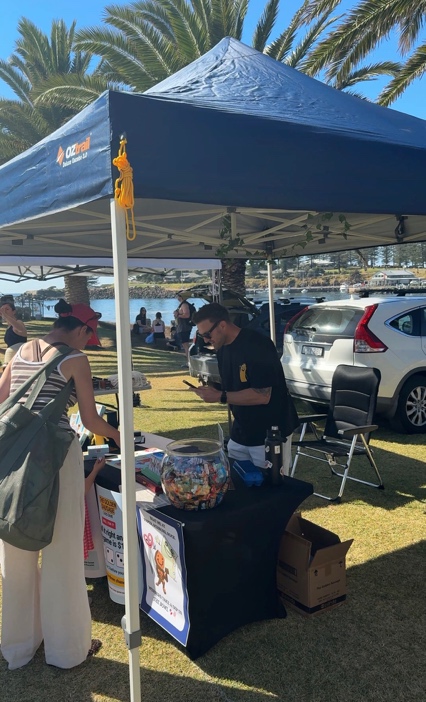
Figure 2. Joel’s Kiama Market stall – Observing the game’s development beyond organised playtesting.
Initially, I worried my later observations weren’t substantial enough because I wasn’t analysing gameplay as intensely. Looking back, I think the findings had simply become less obvious. The game was becoming something people asked us to bring along, played independently and associated with spending time together. My role had changed from introducing people to the game to watching it become part of their lives.
I think this is something really special about games. They create opportunities for connection, competition and shared experiences that extend beyond the person who first introduces them. MDA remained valuable for analysing gameplay, but was less suited to explaining the game’s growing social presence. Recognising this helped me understand that my project had evolved rather than lost direction.
What surprised me most was how much The Golden Sausage grew outside university while I was completing the subject. Breaking the project into manageable weekly entries also helped me maintain momentum and reflect while observations were fresh.
I am happy with the candid, personal approach I chose. A future study could incorporate more qualitative or quantitative methods to investigate player experiences more systematically, with appropriate ethics approval. For this DA, I wanted to keep the project manageable and grounded in everyday interactions.
Future Directions and Potential Impact: Beyond the Assessment
My next step is to share the completed portfolio with Joel as a resource he may find useful for future development. I would love to understand more about his design decisions, including the player limit, team gameplay and stories behind the card illustrations, many of which were inspired by his family. If I continued the project, I would also love to explore tournament-style gameplay to investigate how repeated competitive rounds influence strategy and interaction.
I hope my DA offers Joel a useful record of how different people experienced his creation and perhaps prompts a few new ideas or lightbulb moments. I’m also proud to have introduced the game to new audiences, particularly university students who may not otherwise have encountered it.
Ultimately, I began this project wanting to understand how The Golden Sausage works. Eleven weeks later, I have a much greater appreciation for how games develop through the people who play them, share them and make them part of their lives.
References
Adams, RS & Atman, CJ 1999, ‘Cognitive processes in iterative design behavior’, FIE’99 Frontiers in Education. 29th Annual Frontiers in Education Conference, vol. 1, pp. 11A6/13–11A6/18, doi:10.1109/FIE.1999.839114.
Bendixen-Noe, M 2010, ‘Bringing play back to the classroom: How teachers implement board and card games based on academic learning standards’, Proceedings of the European Conference on Games Based Learning, pp. 13–18.
Canva Pty Ltd 2026, Canva, online design platform, viewed 16 October 2026, https://www.canva.com/.
Chircop, D 2016, ‘An experiential comparative tool for board games’, Replay: The Polish Journal of Game Studies, vol. 3, no. 1, pp. 11–28, doi:10.18778/2391-8551.03.01.
Choi, JO, Forlizzi, J, Christel, M, Moeller, R, Bates, M & Hammer, J 2016, ‘Playtesting with a purpose’, Proceedings of the 2016 Annual Symposium on Computer-Human Interaction in Play (CHI PLAY ’16), Association for Computing Machinery, New York, pp. 254–265, doi:10.1145/2967934.2968103.
Dillon, R 2010, On the way to fun: an emotion based approach to successful game design, A K Peters, Natick, MA.
Hunicke, R, LeBlanc, M & Zubek, R 2004, ‘MDA: A formal approach to game design and game research’, Proceedings of the AAAI Workshop on Challenges in Game AI, AAAI Press, San Jose, CA.
Issifou, ST, Hylving, L, Kumnova, D & Raftopoulos, M 2026, ‘Game-based learning: An experiential card game in higher education’, Proceedings of the 59th Hawaii International Conference on System Sciences, pp. 4911–4920, doi:10.24251/HICSS.2026.587.
Martínez Elizalde, L, Astengo Noguez, C & López Salas, D 2025, ‘Unveiling the secrets of successful game design’, 2025 IEEE CHILEAN Conference on Electrical, Electronics Engineering, Information and Communication Technologies (CHILECON), doi:10.1109/CHILECON66915.2025.11476091.
The Golden Sausage Card Game 2026, The Golden Sausage Card Game, viewed 16 October 2026, https://thegoldensausagecardgame.com/products/golden-sausage-card-game.


Leave a Reply